International Day Celebration Ideas for the Classroom
October 15, 2026 · 6 min read
By The I Survived Room Parent Team
The teacher says, "Let's do an International Day!" and your brain goes straight to 22 families, 14 countries, one allergy list and a single table outlet. It's one of the most meaningful days of the year. It's also the one most likely to turn into a potluck plan with 47 replies.
Here's how to keep an International Day celebration warm, respectful and doable: themes, food tips, one craft, one game and a planning timeline, the I Survived Room Parent way.
Our Party Rule (Passports Optional)
Every class celebration we plan follows the same formula:
Kids stay at their tables. No stations, no lines, no "visit every country" laps around the room.
Food: something to share, something kids will actually eat, and maybe one fun new thing.
One craft.
One game.
No booths. Not a booth per country, not a booth per family. Ever.
Simple keeps the teacher happy, the volunteers sane and the focus on the kids. New to the job? Our room mom guide covers everything from the first email to the last party.
Step One: Check In With the Teacher
International Day can mean very different things from school to school. Before you send a single email, ask the teacher:
Is this a class celebration, a school-wide event or a unit wrap-up?
What's the date, time and length? 30 to 45 minutes is plenty for one class.
Is the class focusing on students' family backgrounds, a few countries the class studied or the whole world?
What are the school food rules? Many schools only allow store-bought food, and that rule usually wins.
What's on the allergy list?
Can families visit to share a song, a word, a story or a photo?
Keep It Respectful (and Fun)
This is the part that matters most. A few simple rules keep everyone comfortable:
Sharing is always optional. Some families love to share their culture. Some don't, and some kids have more than one background, or aren't sure. "Pick any place you'd like to learn about" works for everyone.
Never ask a child to "represent" a country. Kids are kids, not spokespeople.
Culture is not a costume. If kids want to wear something special from their family, wonderful. Skip "dress up as a country" themes, wigs and anything that turns a culture into a joke.
Real over stereotypes. Photos, maps, music and real words from real families beat cartoon versions every time.
Let families lead. If a parent offers to teach "hello" in their language, that's the best five minutes of the day.
Pick a Theme
You don't need a big theme. Pick one and let the craft and game do the work:
Passport Around the World: every kid gets a paper passport and collects a "stamp" for each place the class learns about.
Hello, World: learn to say "hello" and "thank you" in a few languages from class families.
Our Class Map: a big world map where kids add a sticker for places their families come from, have visited or dream of visiting.
Games Around the World: a few simple table games played by kids in other countries.
Want more theme ideas for the year? See our holiday party planning themes.
International Day Food Ideas
Food is where International Day gets tricky. A homemade dish from every family sounds lovely, and then you're reading 22 ingredient lists at 11:47 p.m. Here's what works:
Follow the school's food rule first. If it's store-bought only, it's store-bought only, even for Grandma's famous recipe.
Keep it to tasting cups. Small portions, one or two items per family who wants to share, and no pressure to bring anything.
Label everything. Name of the food, where it's from and the main ingredients. Ask families to note common allergens.
Have a "safe" plate. Fruit, crackers or rice cakes at every table, so every kid has something to eat.
One main, still. If the class is doing a full meal, list one main on the sign-up and let the rest be small tastes.
Easy store-bought ideas: fruit like mango, kiwi or clementines, rice crackers, pita and hummus, tortilla chips and mild salsa, plain naan, cheese and crackers, and simple cookies from different countries.
Drinks: water bottles or juice boxes. One or two choices is plenty.
Paper goods: plates, napkins, small tasting cups, spoons, labels, a marker, gloves for whoever is serving and an extra trash bag or two.
Check the allergy list before anything goes on a plate. Our allergy-friendly class snacks post has lots of safe swaps.
Set Up the Sign-Up
A typical class of 20 to 25 might look like this:
Tasting foods (optional, labeled): 4 to 6 slots
Fruit and "safe" snacks: 2 slots
Drinks: 1 slot
Plates, napkins, tasting cups and labels: 1 slot
Craft supplies: 1 to 2 slots
Family share (a word, a song, a photo or a story): 3 to 5 short slots
Add the allergy list (allergens only, never names), the school's store-bought or homemade rule and the number of servings to each slot. Our SignUpGenius tips for class parties walk through it, or use the free class party sign-up sheet if your class prefers paper.
Pro tip: Make the family-share slots five minutes each, max. Otherwise the slideshow of someone's trip runs longer than the party.
One Craft: A Paper Passport
Pick one:
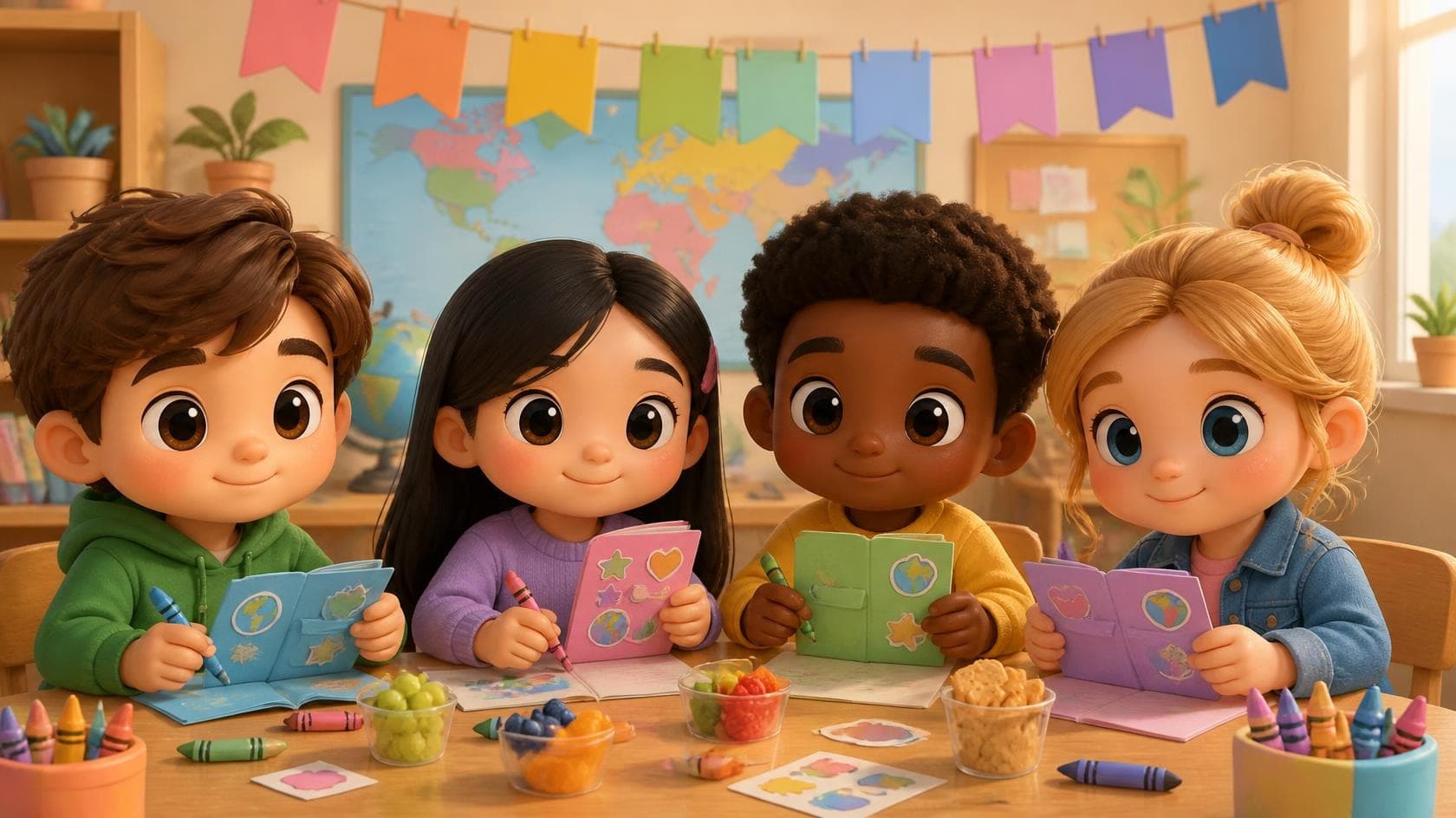
Paper passport: a folded booklet with a cover, a page for "my name and my photo" (a drawing works), and a few blank stamp pages. Kids collect stamps or stickers during the game.
"Hello" flags: a small paper flag shape where kids write "hello" in a language of their choice and decorate it. String them into one class banner.
My Family Page: a simple page for "Something my family loves to eat, say or celebrate." Every family has an answer, wherever they're from.
Pre-cut everything, use glue sticks (nothing that has to dry) and bring a finished sample. Pack a few extra coloring sheets for kids who finish early.
One Game: Keep It at the Tables
Passport stamp quiz: read a fun fact about a place, and each table guesses where it is on the class map. Correct guesses earn a passport stamp.
Say hello: practice "hello" in five languages, then call one out and see which table can name it.
Games around the world (seated): rock paper scissors (played in many countries under different names) or a simple hand-clapping game a family teaches the class.
Planning Timeline
5 weeks before: confirm the date, focus, food rules and allergy list with the teacher.
4 weeks before: send a short note inviting families to share, with "totally optional" in bold.
3 weeks before: send the sign-up.
2 weeks before: collect craft supplies, print passports and gather a world map.
A few days before: confirm the family-share schedule and the food labels.
Celebration day: arrive early, set tables, share, taste, craft, game, clean up. Then go home and say "thank you" in at least one new language.
Want it all on one page? Grab the free class party checklist. Planning a cultural celebration later in the year? Our Lunar New Year class party ideas use the same simple, respectful approach.
Frequently Asked Questions
What do you do for International Day at school?
Keep it simple: a few labeled tasting foods, one craft like a paper passport, one game like a map quiz, and short, optional family shares. About 30 to 45 minutes is plenty for one class.
How do I make International Day inclusive?
Make sharing optional, let kids pick any place to learn about, never ask a child to represent a country and skip costume-style themes.
What food should we bring for International Day?
Follow the school's food rule first. Small, labeled tasting cups work best, with fruit or crackers at every table so every kid has something safe to eat.
What is an easy International Day craft for kids?
A paper passport, a "hello" flag banner or a My Family page. Pre-cut the pieces and use glue sticks.
Can families come in to share their culture?
If the teacher says yes. Keep each share to about five minutes: a word, a song, a photo or a short story.
What if a family doesn't want to share?
That's completely fine. Nobody has to share anything, and every kid can still join the craft, the game and the food.
Questions or an International Day win to share? Email us at contactus@isurvivedroomparent.com. Hello, goodbye and thank you, in every language!
Survived this one? Wear it proudly.
Shop the tees